The Waterproofing Bible: AS 3740 Compliance Guide
What QLD certifiers check before you lay a single bathroom tile.
CoastHomeHub Engineering · 9 min read · Updated 22/06/2026
The Substrate prep (Crucial Foundation)
Waterproofing never fails on its own; it fails because the substrate underneath moves, cracks, or rots. Under Australian Standard AS 3740, the wall and floor sheeting must be completely rigid and securely fastened. For timber-framed floors, compressed fiber cement (CFC) sheeting of at least 19mm is required, or certified structural-grade subflooring.
Before applying the liquid membrane, all gaps, screw holes, and joints must be filled with a polyurethane sealant (such as Sikaflex 11FC). The substrate must be vacuumed clean of all plaster dust and primed with a specialized solvent or water-based primer to guarantee membrane adhesion.
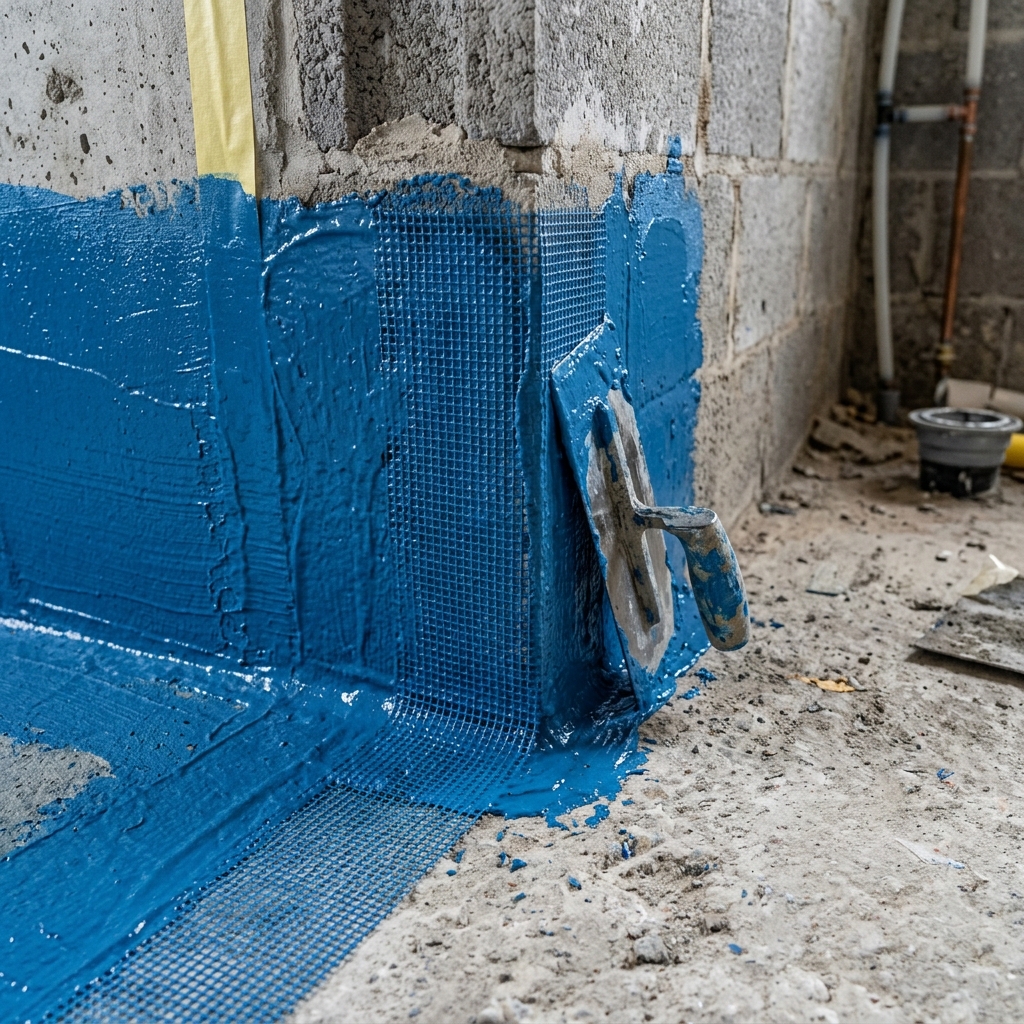
Figure 4.1: Close-up of professional Class III liquid membrane application over joint reinforcement mesh at a bathroom wall-to-floor junction.
Bond Breakers & Flashing (The AS 3740 Core)
A membrane must be able to stretch if the building settles. If you paint membrane directly over a joint, any movement will tear it. AS 3740 mandates the use of a 'bond breaker' at all wall-to-floor and wall-to-wall intersections. This is achieved by installing a flexible backing rod or elastic sealing tape over a polyurethane fillet.
For showers, the waterproofing must extend at least 150mm up the wall sheets from the finished shower floor level. In frameless shower designs, the entire bathroom floor must be waterproofed, and a water stop angle (a metal or plastic L-profile) must be anchor-fixed at the doorway to prevent water wicking into the hallway carpets.
Form 16 Certification and QBCC Penalties
In Queensland, a waterproofing contractor must hold a specific QBCC Waterproofing Licence. Upon completion of the membrane cure, the applicator must issue a Form 16 (Inspection Certificate) to the building certifier. Doing waterproofing work without a license or failing to supply a Form 16 can lead to severe fines and renders home warranty insurance completely void.
Frequently Asked Questions
How many coats of waterproofing are required?
Typically, two liberal coats are required to achieve the manufacturer's specified dry film thickness (usually 1.0mm to 1.2mm). Each coat must be applied perpendicular to the previous one.
What is a Form 16 in QLD waterproofing?
It is a statutory building certificate of inspection signed by a licensed waterproofing installer, certifying that the wet area works comply with the Building Code of Australia and AS 3740.