The Spa Ensuite: Microcement & Backlit Mirror Detailing
Grout-free seamless walls, class-3 waterproofing compliance, and ambient color temperature specification.
CoastHomeHub Editorial · 7 min read · Updated 22/06/2026
The Visual Expansion: Seamless Microcement Walls
Traditional bathroom tiles create a grid of grout lines that can make small bathrooms feel busy and enclosed. Microcement — a composite coating based on cement, water-based resins, and silica sand — offers a completely seamless finish that flows across floors, walls, and even vanity benches.
This lack of grout lines provides a clean, unbroken canvas that makes the space feel visually larger and calmer. The hand-applied texture adds warmth and depth that tiles cannot replicate, giving the ensuite an organic, residential spa character.
“Microcement is a premium hand-applied finish. The beauty lies in the subtle trowel marks and texture variations created by the artisan.”
— Paddington Tiling & Waterproofing
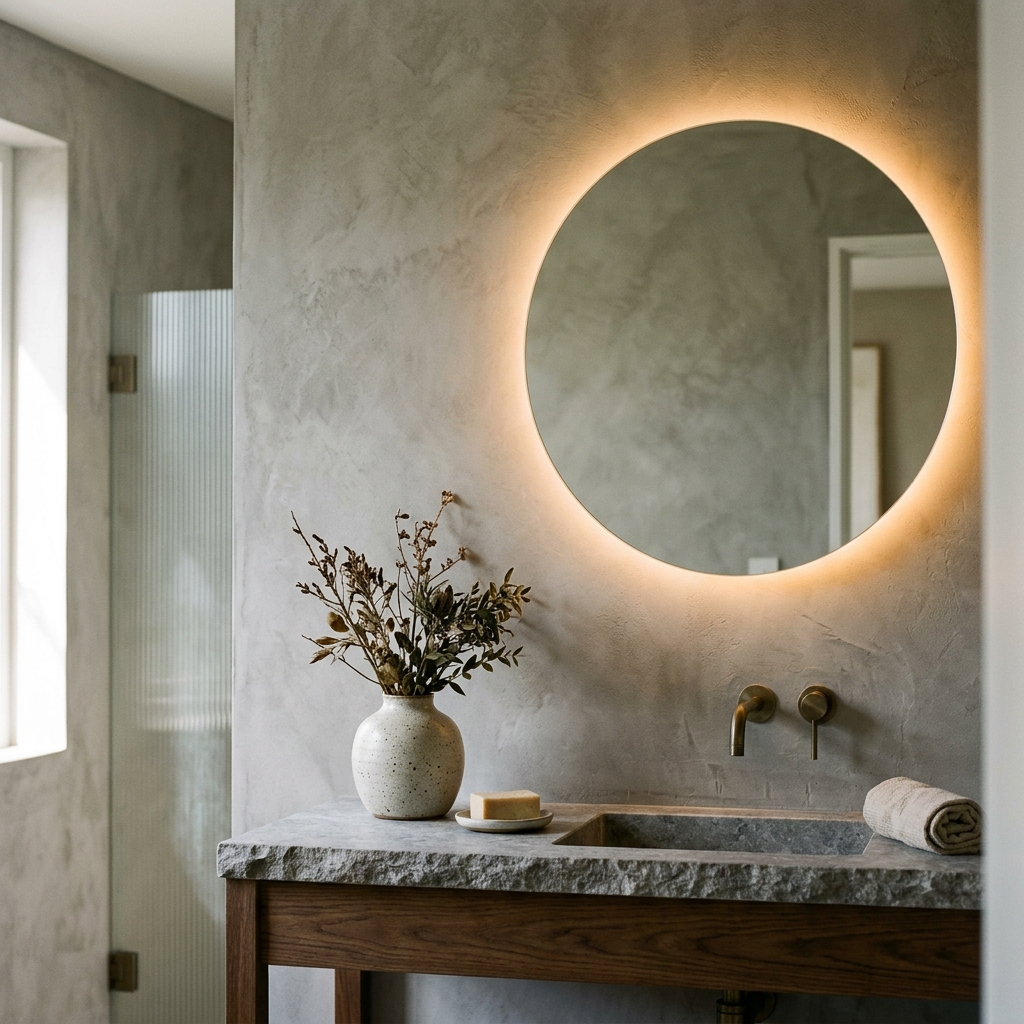
Figure 8.1: A minimalist vanity area featuring warm backlit round mirror, grey microcement walls, raw stone sink, and gold hardware.
Technical Waterproofing Under Microcement
A common misconception is that microcement itself is waterproof. While the polyurethane sealer coats prevent surface water penetration, Queensland building certifiers require a fully compliant Class 3 waterproofing membrane underneath.
Any movement in the subfloor (timber framing) will crack the microcement. Applying an elastic, fiber-reinforced liquid or sheet membrane is mandatory before the base render coats are troweled on.
Illuminating the Space: Backlit Mirror Specification
To bring out the organic texture of microcement walls, use raking light. A round backlit mirror creates a soft halo of light that highlights the subtle trowel variations while eliminating harsh shadows on your face.
For master bathrooms, specify 2700K (warm white) LEDs to create a relaxing evening ambiance, and wire it to a secondary dimmable circuit separate from the bright overhead downlights.
Frequently Asked Questions
Is microcement slippery on bathroom floors?
No. Microcement can be finished with varying grades of silica sand in the final sealer coat to achieve the required R10 or R11 slip resistance class for residential bathrooms.
Can you apply microcement over existing tiles?
Yes. Provided the existing tiles are structurally sound, flat, and not leaking, a specialized epoxy primer and mesh can be applied to bond the microcement directly over the old tiles without demolition.